


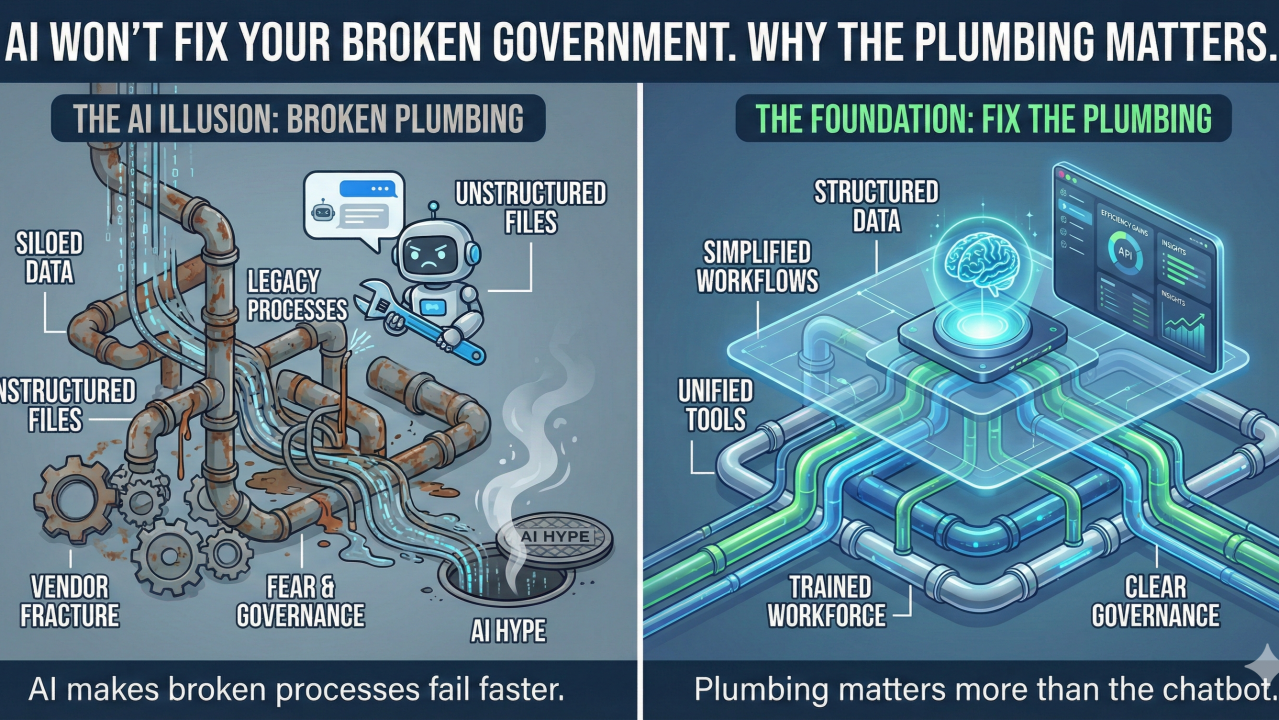
Why the Plumbing Matters More Than the Chatbot: The Diagnosis
Introduction: The Efficiency Gap
Local governments across the country are hitting a familiar wall. The excitement around Artificial Intelligence rises like steam from a freshly opened manhole cover, yet the measurable outcomes remain stubbornly ordinary. A recent Gartner survey highlights the contradiction with numerical precision: 74% of CFOs anticipate AI-driven efficiency. A mere 5% have actually witnessed it. One can almost hear the collective sigh of spreadsheets everywhere.
In a recent interview, Microsoft CEO Satya Nadella offered an unusually candid observation that explains a great deal.
“AI doesn’t fix broken processes. It makes broken processes fail faster.”
Local government provides an almost perfect demonstration of his point.
The Faster Mess in Local Government
When speed meets dysfunction, efficiency does not suddenly appear. Instead, you get a hurried version of the original problem.
- The Shadow Record. A clerk drafts a quick email using ChatGPT on a personal phone. Without intending to, they create a public record that sits entirely outside the county’s systems and FOIA retention schedules. An invisible file with real legal consequences.
- The PDF Cemetery. A department publishes thousands of scanned PDFs. They purchase a highly advertised chatbot, only to learn the bot cannot read images and now improvises answers (hallucinates) with great confidence. Residents are eventually instructed to call instead.
- The Automation Trap. A staff member attempts to automate a form built in 1998. The tangle of exceptions, caveats, and historical curiosities requires more time to explain than the form requires to complete.
In each example, the culprit is not the AI. The issue is the plumbing the AI is expected to navigate.
The Four Pillars of Failure
Nadella describes four prerequisites for AI success: Mindset, Tool Set, Skill Set, and Data Set. Local governments tend to struggle with all of them at once, which is impressive in its own bureaucratic way.
1. Mindset: Automating the 1970s
One recurring error is the impulse to automate a process that probably should have been retired several administrators ago.
- Local Case. In Van Buren County, parcel splits required emailed sketches, scanned deeds, and data retyped into three separate systems. Applying AI to this workflow would simply accelerate the underlying eccentricity. A more helpful question emerges: Why is the workflow built this way at all? The answer often involves tradition, a retired staffer named Karen, and a filing cabinet that everyone avaids opening.
2. Tool Set: The Vendor Fracture
Departments often select software in the same way residents choose lawn fertilizers. Each picks their favorite, often based on legacy preference, a persuasive salesperson, or flashy packaging making promises that never quite materialized.
- Local Case. St. Joseph County has data spread across SharePoint, personal OneDrives, email attachments, and proprietary vendor clouds. Attempting to build a unified AI assistant on top of that landscape resembles teaching a cat to file.
AI does many things well. Acting as glue between unrelated systems is not one of them.
3. Skill Set: Fear and Governance
AI adoption rarely stalls because of inability. Uncertainty is the usual culprit. Staff are not intimidated by the concept of AI. They are concerned about FOIA, accountability, and the possibility of explaining to a supervisor why a bot sent a resident to the wrong meeting.
- Local Case. When we deployed early AI tools, curiosity was high. The hesitation came from the absence of clear governance. Without training, oversight, and a shared understanding of guardrails, the safest option is inaction.
4. Data Set: The Hardest Link
Nadella put it plainly. If your data is siloed, your AI will be useless.
Local governments excel at spatial information. GIS teams can map anything from zoning districts to the location of a troublesome raccoon. The rest of the information landscape is less cooperative. Ordinances live in Word documents. Minutes drift across unstructured text. Historical records remain entombed in scanned PDFs. Without a machine-readable layer of truth, AI has nothing to reason over.
Conclusion: Fix the Plumbing First
The lesson for administrators and elected officials is consistent across communities. An AI solution cannot repair a process problem. Any system built on top of duct-taped workflows will eventually inherit every flaw.
If you want the efficiency that Gartner’s 74% are waiting for, there is no substitute for the quiet, unglamorous work. Simplify the workflow. Unify the tools. Train the workforce. Structure the data.
Plumbing is seldom exciting, yet everything depends on it. AI can offer remarkable speed and insight, but only after the pipes beneath it can carry the load.
In the next article of this series, we’ll look at the first fix: why I believe the mindset shift must come before a single line of automation.
Author’s Note:
Here in Van Buren and St. Joseph Counties, we’re putting real time and curiosity into AI and automation. We are learning as we go, occasionally tripping over our own cables, and sharing what we discover along the way. If you find these insights useful, I would love to know.
Despite the confident promises in vendor brochures, there are no true experts yet. We are all charting this terrain together, which is oddly reassuring. So bring your questions, your half-formed ideas, and even the things you are not quite ready to admit you don’t understand.
Let’s sort this out collectively, one practical step at a time.
Source Acknowledgement: The quotes and dialogue attributed to Satya Nadella are sourced from the YouTube video: Microsoft CEO Satya Nadella: AI Boom, Energy Battle & His Complicated Alliance with Sam Altman