


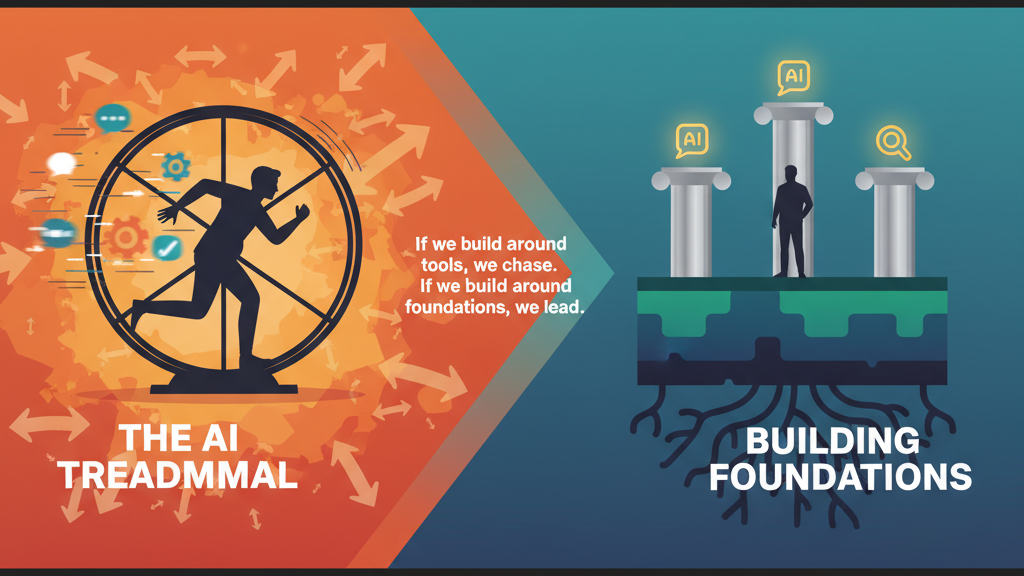
AI is moving fast. Faster than local government’s project cycles, faster than our procurement timelines, and definitely faster than anyone’s comfort zone.
Every week brings another shiny new chatbot, analytics tool, or vendor pitch promising to “transform” how government works. It’s tempting to dive in, launch a pilot, spin up a demo, test the latest thing. Some of those experiments are valuable. But here’s the hard truth we’ve learned from decades of public sector technology:
If we build around tools, we chase. If we build around foundations, we lead.
That lesson has been repeated through every major technology wave. The difference between those who thrive and those who rebuild every few years isn’t luck or budget. It’s whether they invested in what lasts.
The Real Lesson of Every Government Tech Wave
Every big shift follows the same story arc:
- A promising tool appears.
- Everyone experiments.
- Most projects fade.
- A few build the deeper layer of infrastructure underneath, and that’s what endures.
So if you’re wondering how to make smart, future-ready investments in the AI era, the question isn’t which tool to pick. It’s:
What will still matter when the tool is gone?
GIS: When the Map Became the Infrastructure
Back in the 1960s, GIS wasn’t a product, it was a government experiment. Canada wanted a digital inventory of its natural resources, and a few institutions (Harvard’s Computer Graphics Lab among them) built the first systems to make it possible.
The early software was clunky, complex, and constantly changing. But the real breakthrough wasn’t in the interface, it was in the data. Governments began turning their paper maps into standardized, interoperable digital layers: parcels, zoning districts, roads, hydrology.
The tools changed names a dozen times. The data foundation stayed. And today, that infrastructure quietly powers 911 systems, property taxes, emergency management, and infrastructure planning.
GIS wasn’t a revolution in software, it was a revolution in structure.
Open Data: The Portal Wasn’t the Point
When open data arrived in the 2000s, every city launched a website. Most of them failed—not because people didn’t care about transparency, but because the underlying data wasn’t maintained. The successful cities learned that what mattered wasn’t the portal; it was the pipeline.
Reliable data. Clear governance. APIs that don’t break on Mondays.
Those are the things that made open data last.
Cloud: Vendors Changed. Architecture Stayed.
When governments moved to the cloud, we obsessed over choosing the “right” provider. Over time, we realized success wasn’t about the logo on the invoice, it was about how we architected systems to scale, stay secure, and maintain control of our own information.
The providers changed. The architecture persisted.
AI Is Following the Same Pattern (Just Faster)
Today, AI is having its GIS moment (and its open data moment, and its cloud moment) all at once. Everyone’s experimenting. Chatbots, copilots, automated assistants. Some of it’s brilliant. Some of it’s chaos.
But the long-term value of AI won’t come from any single model or product. It will come from the same thing that made GIS, open data, and cloud work:
clean, structured, trustworthy data and strong governance beneath it.
AI is like an engine. If you feed it good fuel, it runs beautifully. If you feed it bad data, it generates confident nonsense, and in government, confident nonsense can cause real harm.
So the work that matters most isn’t glamorous. It’s building the foundation that every future tool will depend on.
What We’re Building with DICE
That’s exactly what we’re doing in Southwest Michigan with the Digital Innovation Collaborative Exchange (DICE).
We’re just beginning this work, but we’re building it the right way.
Yes, we’re developing flashy tools, automations, analytics, and communication systems that help counties serve residents more efficiently. But beneath all that, we’re building the shared foundation that will make those tools resilient, interoperable, and ready for the next wave of AI.
Here’s what that looks like in practice:
- Authoritative Data Layer — A shared PostgreSQL/PostGIS data warehouse, so counties work from the same trusted source.
- APIs That Last — Standardized, automated connections that let tools plug in easily—without messy rebuilds every time technology shifts.
- Strong Governance — Clear rules for data accuracy, security, and accountability. Because in public service, trust is the product.
- AI as a Plug-In — AI tools are treated as replaceable components, not permanent platforms. The foundation doesn’t depend on any one vendor.
We’re early in this journey, but we believe this is the future. Because if the history of technology has taught us anything, it’s that building the foundation first isn’t slower, it’s smarter.
Why This Matters
The pattern repeats:
- GIS showed that the data layer matters more than the map software.
- Open data showed that governance matters more than the website.
- Cloud showed that architecture matters more than the vendor.
- AI will show that infrastructure matters more than the chatbot.
If we want to avoid rebuilding every few years, we need to invest in what lasts: standards, data, governance, and shared systems.
That’s what DICE is doing, not chasing tools, but building the ground they’ll stand on.
The Bottom Line
We’re just getting started. But we’re not starting with a shiny pilot or a single vendor. We’re starting with the foundation, because that’s what will still be standing when the current generation of AI tools has been replaced (probably twice).
In an age of acceleration, endurance is the real innovation.
Let’s build for it.
Author’s Note: DICE (Digital Innovation Collaborative Exchange) is a shared digital services initiative led by Van Buren and St. Joseph Counties, Michigan. One of our core missions is to build durable, AI-ready infrastructure for rural governments, because progress should be built to last