


(I recently had the pleasure to participate on a recent panel hosted by The Elections Group and the AI & Elections Clinic)
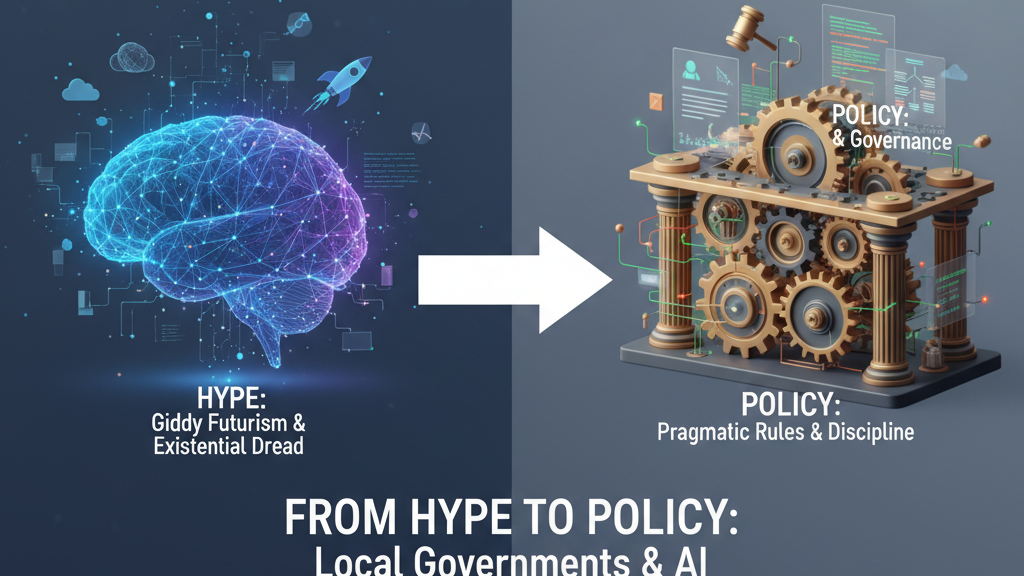
When it comes to artificial intelligence, local government discourse tends to veer between two equally unhelpful poles: giddy futurism and existential dread. One side promises AI-powered utopias where forms fill themselves and potholes preemptively apologize. The other envisions HAL 9000 taking over the permit system. Both, as it turns out, are poor substitutes for actual governance.
What our panel at From Hype to Policy: Managing AI Use Policies in Election Offices underscored was this: the path forward isn’t fear, and it isn’t blind faith. It’s the slow, sensible middle lane known as policy discipline with a side of practical experimentation which, let’s face it, is as close to excitement as local government should probably get.
Start With Governance, Not Gadgets
Our county’s AI journey didn’t begin with a glossy vendor pitch or someone shouting “We need ChatGPT on everything!” It began with GPT-4’s release and the quiet, dawning realization that staff were going to start using it whether we had a plan or not.
So, we formed an AI Task Force with representation from every department, then codified it with an AI Steering Committee made up of commissioners and department heads. Governance, in this case, wasn’t something tacked on after the fun had already started. It was the fun. (Well, fun-adjacent.)
Letting AI seep in informally through unsanctioned Copilot experiments is the bureaucratic equivalent of leaving the back door open and being surprised when the raccoons form a union. Better to write the rules before the technology becomes invisible.
Build on What Already Works
We didn’t invent an entirely new layer of bureaucracy (tempting though it was). Instead, we built on the rules we already had: data security, PII protection, CJIS compliance. These policies had already weathered more than a few storms.
By layering AI guidance on top, we did two things:
- Avoided policy fatigue (which is a real medical condition in government staff, probably), and
- Reinforced the idea that AI is just another tool, not a magical exception to every existing standard.
In short: AI doesn’t need its own throne. It needs a seat at the same old, slightly squeaky table.
Train for Reality, Not Fantasy
The best safeguard isn’t encryption, or enterprise licensing, or a sternly worded memo. It’s people. Specifically, people who know what they’re doing.
In Van Buren County, our staff complete mandatory AI training and pass a test before getting unrestricted access. The training doesn’t sugarcoat it: AI is powerful, yes. But it also hallucinates, lies with confidence, and occasionally gaslights like a malfunctioning Roomba.
The core principle is blunt but necessary: you are responsible for the output, not the algorithm. Because when the press calls, “the chatbot did it” is unlikely to satisfy.
Policy by Practice
Yes, we used AI to help draft our AI policy. No, it didn’t try to declare itself the County Administrator.
We fed our existing rule sets into the model to help identify policy gaps, a modest, useful application that removed some guesswork. From there, we built whitelist/blacklist guidance for tools and platforms. Not perfect, but better than “ask around and hope.”
Beyond Just AI: The Digital Innovation Task Force
The AI Task Force eventually evolved into something broader: the Digital Innovation Task Force. It now meets twice a month with judges, clerks, and elected officials to tackle the wider set of digital dilemmas: automation, analytics, data overload, and the ever-popular issue of public trust.
Facing Skepticism Head-On
Public skepticism isn’t a nuisance to be managed, it’s a signal to be read. And while AI probably isn’t coming for your job, the person who knows how to use it just might. Pretending otherwise only breeds resentment and leaves staff unprepared.
So we choose honesty, paired with accountability. AI isn’t magic. It’s a tool. But so was fire, and we still made a lot of rules about where you can put it.
The Takeaway
AI is already in the building. It’s probably filled out a timesheet and made an awkward joke in the staff meeting. The question is whether we write the rules now or wait until we’re reverse-engineering disaster recovery from someone’s well-intentioned experiment in the budget spreadsheet.
Governance is the difference between hype and policy. And governance, as ever, starts with us.