


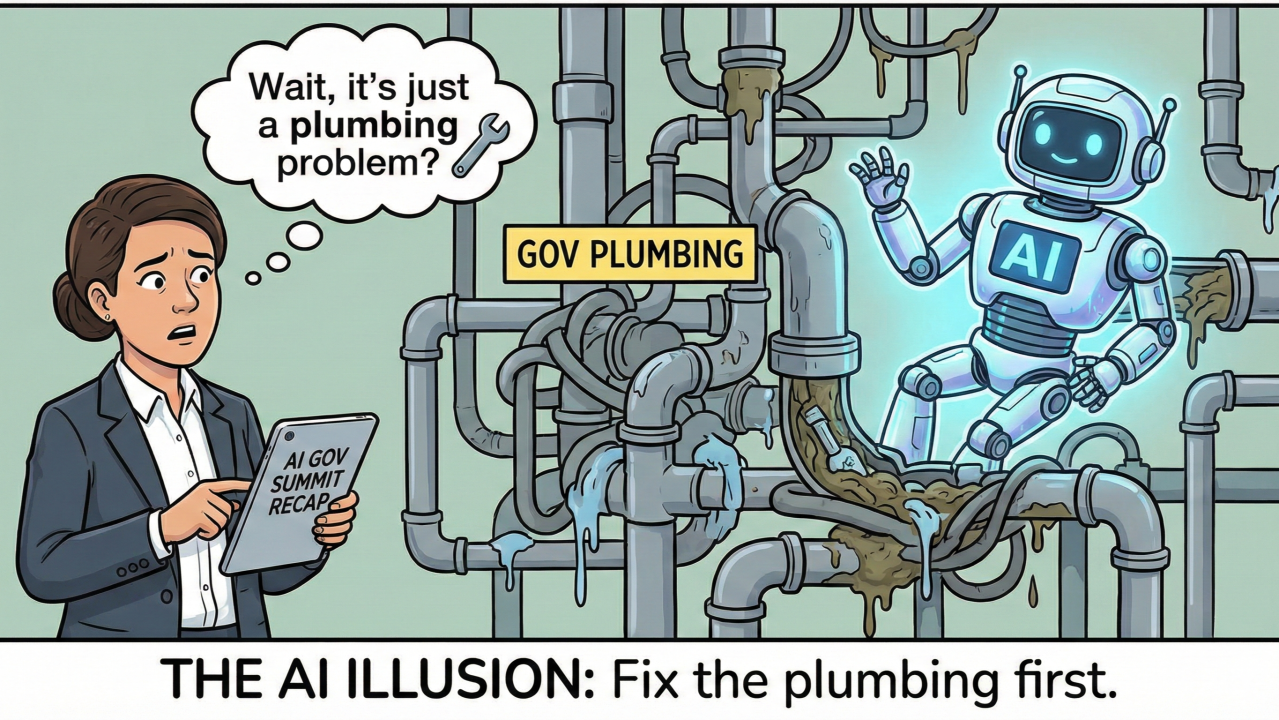
The GovAI Coalition Summit wrapped a couple of weeks ago. Like many of you living in the quiet limbo of small local government travel budgets, I couldn’t attend. Fortunately, the organizers released the full recap and session notes. Twenty-five PDFs, neatly matching my ChatGPT Project upload limit, as if the universe briefly agreed to be helpful. A few prompts later, one message rose to the surface with the persistence of a meeting reminder that refuses to go away.
AI is not a technology problem. It is a governance, data, and organizational readiness problem wearing a very confident smile.
Across every topic, whether procurement, permitting, or police reporting, the pattern was unmistakable: AI accelerates whatever system it touches. When the system is strong, AI adds lift. When the system is creaking under its own weight, AI simply accelerates the wobble. The tools behave with perfect consistency. It is the structures beneath them that introduce the surprises.
The Summit surfaced a handful of truths that local governments keep rediscovering:
- Governance sets the trajectory. Clear authority, thoughtful guardrails, solid contracts, and communication channels that do not require heroic detective work. These elements shape outcomes long before the model ever processes a prompt.
- Data quality remains the universal bottleneck. The permitting, policing, and planning teams all ran into the same obstacle. Outdated or unstructured data turned promising tools into patient creatures waiting for the world to catch up. Most failure stories could be traced to content that needed more attention than anyone expected.
- Pilots reveal organizational gaps. The most valuable pilots were not the ones that scaled instantly. They were the ones that exposed hidden process issues, mystery workflows, and data that had been quietly aging in file structures no one wanted to open.
- Training and culture outweigh technical novelty. Staff want clarity, guardrails, and practical examples. The uncertainty surrounding AI tends to slow adoption far more effectively than any hardware limitation.
- Trust is the currency of public-sector AI. Trust across agencies. Trust with vendors. Trust with residents. Progress tends to follow it, and stalls when it is absent.
- Partnership outperforms procurement alone. Jurisdictions that co-developed solutions or worked collaboratively across regions advanced more quickly. The traditional procurement model struggled to keep pace with the speed of iterative AI work.
- AI exposes blind spots instantly. Old workflows, undocumented tribal knowledge, shadow IT, ambiguous authority, and siloed data all surfaced the moment AI entered the room. The tools did not create the problems. They simply made them easier to see.
The Core Insight AI will not succeed in government until the fundamentals are modernized. Governance, data quality, process clarity, training, and trust form the real infrastructure for this work. This is good news. The most important steps do not require bleeding-edge models or dramatic reinvention. They require consistency, coordination, and data that can survive a close look.
The jurisdictions that invest in these foundations are already moving faster. Those that skip them may find themselves sprinting in a circle and arriving exactly where they started, only slightly out of breath. For anyone working in local government, the takeaway is refreshingly practical.