


This is the final article in a series on AI Sovereignty and the Knowledge Layer. The earlier pieces explored the risk of cognitive lock-in and sketched an architecture for a sovereign stack. What remains is the least theoretical question of all: how does any of this happen when your budget is thin, your staff is smaller still, and no one has a playbook?
The Math Still Does Not Work
If you have read this series in order, you may now be experiencing a familiar public-sector sensation. The strategy makes sense. The principles feel right. And somewhere in the back of your mind, a small voice is asking how any of this survives contact with Monday morning.
We have argued that local governments should retain control over their Knowledge Layer; the structured logic and definitions that allow AI systems to interpret our laws and policies without improvising. We have argued for an architecture that separates systems of record from systems of reasoning, so that intelligence can evolve without rewriting history.
As an idea, this feels prudent. Possibly even necessary.
Then reality enters the room.
The IT Director is also the GIS Manager, the Helpdesk Lead, and the person who knows which outlet flickers when the copier warms up. The budget stretches just far enough to keep critical systems running, provided nothing unexpected happens. Something unexpected usually happens.
At that point, the arithmetic reasserts itself.
A single rural county cannot justify an AI architect. It cannot reliably recruit a data engineer. It certainly cannot create a new role dedicated to curating the semantic structure of a zoning ordinance that has been amended piecemeal since the Clinton administration.
Which leaves us with two familiar and unsatisfying paths.
One is to buy a turnkey solution and hope the long-term implications remain manageable. The other is to attempt heroics, overload existing staff, and quietly accumulate a system that works just well enough to be dangerous.
Neither feels like stewardship.
There is a third path. It is less tidy, more experimental, and historically familiar to small governments facing large infrastructure problems.
We stop trying to solve this alone.
The Fiction of the Self-Sufficient County
In the physical world, local governments already understand that independence does not require isolation.
Many rural counties already collaborate on regional planning, economic development, and solid waste management, often through authorities that most residents never notice unless something goes wrong. Smaller jurisdictions share fire protection, water systems, and emergency services because some forms of infrastructure only make sense at scale.
The Knowledge Layer behaves like infrastructure, even if it looks abstract at first glance.
If every jurisdiction attempts to design, build, and maintain its own AI stack, the result will be predictable. Effort will be duplicated. Standards will diverge. Vendors will step in to simplify the mess, and control will quietly migrate outward.
If, instead, we treat the machinery of understanding as something that can be shared while authority remains local, the conversation changes.
A Regional Knowledge Utility, Still Taking Shape
What we are exploring in Southwest Michigan is not a finished model. It is a working hypothesis.
The idea is simple enough to explain, but complex to execute: share technical capability across jurisdictions while preserving local decision-making and ownership.
This does not mean consolidating IT departments or asking local staff to become AI specialists. Most are already operating at full capacity, keeping critical systems functional and secure.
What it suggests is a separate layer, something closer to a utility than a department.
A village does not need its own data scientist. A region might. A township hall does not need to master prompt engineering. It may benefit from access to people who do, and who also understand state law, public records, and the texture of local governance.
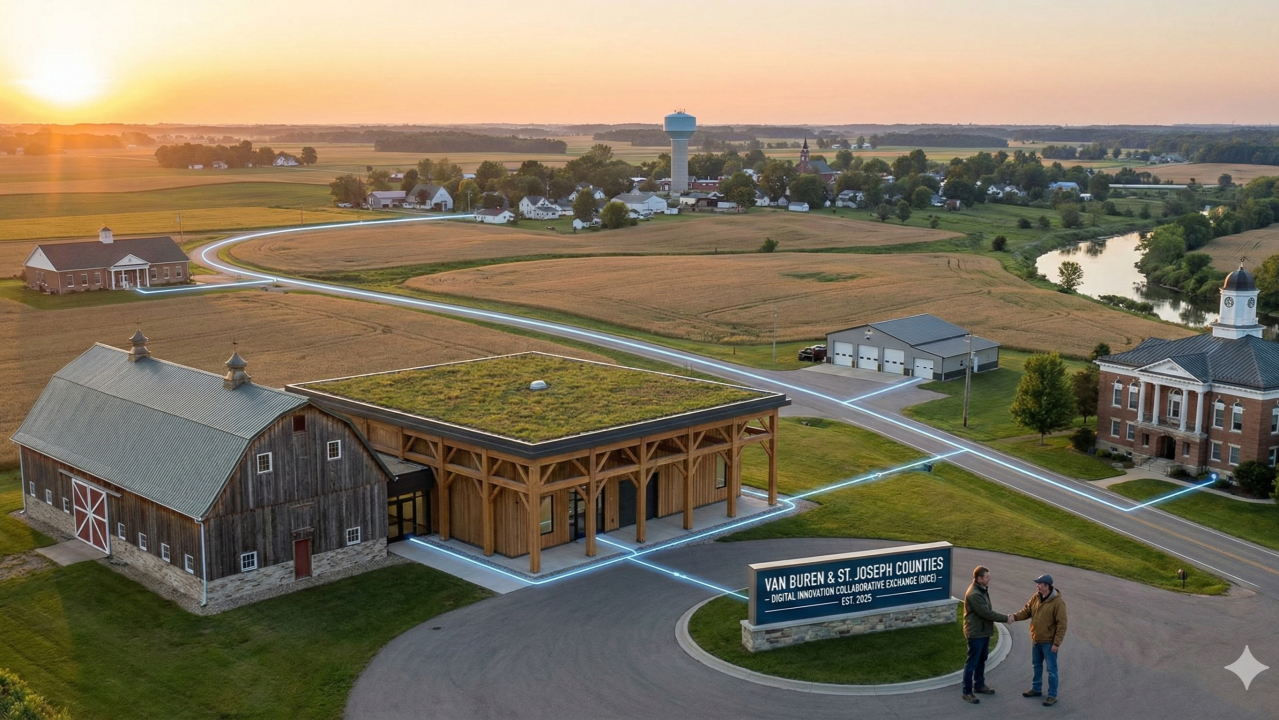
This is the premise behind DICE (the Digital Innovation Collaborative Exchange). It is an intergovernmental partnership between Van Buren and St. Joseph Counties, built on the observation that our jurisdictions differ politically and culturally, but face nearly identical technical constraints.
We are not presenting DICE as a solution we have perfected. We are presenting it as an approach we are actively testing.
The working principle is this: concentrate specialized expertise, while keeping meaning and authority close to home.
What We Are Trying to Build
In practical terms, the collaborative is attempting to develop shared infrastructure. That includes open-source components, retrieval pipelines, and reasoning layers like those described earlier in this series.
The goal is to hire and retain technical talent that no single county could reasonably support, and to do the hard exploratory work once rather than repeatedly.
What remains firmly local is ownership.
Local governments continue to own their records, their definitions, and their decisions. Clerks, planners, and administrators remain responsible for verifying outputs and correcting errors. The system is meant to assist judgment, not replace it.
When a planner in one county asks a question, the shared infrastructure should reason over that county’s records, not a blended or abstracted dataset. That distinction is easy to state and surprisingly difficult to implement, which is precisely why we are approaching it cautiously.
We are learning as we go. Some assumptions will hold. Others will need revision.
For this to work over time, the collaborative itself must be governed carefully. A shared technical platform without clear guardrails risks becoming a public-sector version of the vendor problem we are trying to avoid.
Participation must remain voluntary. Exit must be possible. Standards must be written together and revisited often. Transparency is not optional.
The machinery may be shared. Authority cannot be.
Why This Is Also a Talent Experiment
There is another reason this approach matters, and it has less to do with technology than people.
Small governments struggle to attract and retain specialized technologists, particularly when the bulk of their work inevitably involves operational support. A regional collaborative offers the possibility of roles that are focused, challenging, and connected to public purpose.
We do not yet know if this will fully succeed. We believe it is more plausible than asking each county to solve the problem independently.
At minimum, it gives us a fighting chance.
An Invitation, Not a Blueprint
The era of the lone IT department trying to master every emerging technology is fading. The intelligence age demands specialization and sustained attention.
If we want public institutions to retain control over their own understanding, cooperation becomes a necessity rather than an aspiration.
- To administrators: Look laterally before you look to vendors. Your neighbors are likely wrestling with the same statutes, the same data, and the same constraints.
- To grantmakers: Consider funding regional capacity, not just software acquisition. Tools change quickly. Institutions, when designed carefully, can adapt.
- To technologists: This is unfinished work, full of ambiguity and real constraints. If that sounds interesting, we are already in conversation.
Final Thoughts: Choosing to Try
This series began with a warning about cognitive lock-in and the quiet costs of convenience. It ends without a declaration of success, because success is not something we can responsibly claim yet.
What we can say is that the future of local government AI will hinge less on budget size than on the willingness to collaborate, experiment, and learn in public.
We can remain isolated customers, purchasing packaged understanding one contract at a time. Or we can attempt something harder: building shared capacity while preserving local control, knowing we will make mistakes along the way.
In Van Buren and St. Joseph Counties, we have chosen to try. We are building carefully, revising often, and sharing what we learn as we go.
The door remains open.
Author’s Note
DICE (Digital Innovation Collaborative Exchange) is an intergovernmental initiative being developed by Van Buren and St. Joseph Counties in Michigan. Its aim is to explore whether shared, sovereign digital infrastructure can be built responsibly for rural local governments in the intelligence age. That includes AI, automation, data anlaytics, GIS, and digital communications.
The governance of a regional knowledge utility remains an open question. How authority is constrained, how standards evolve, and how sovereignty is protected over time are issues we are still actively working through. A future piece will focus specifically on what a “constitution for shared intelligence” might require.
We are currently building and testing the Knowledge Layer concepts described in this series. If you are a local government leader interested in learning alongside us, or a technologist drawn to unresolved problems that matter, we should talk.