


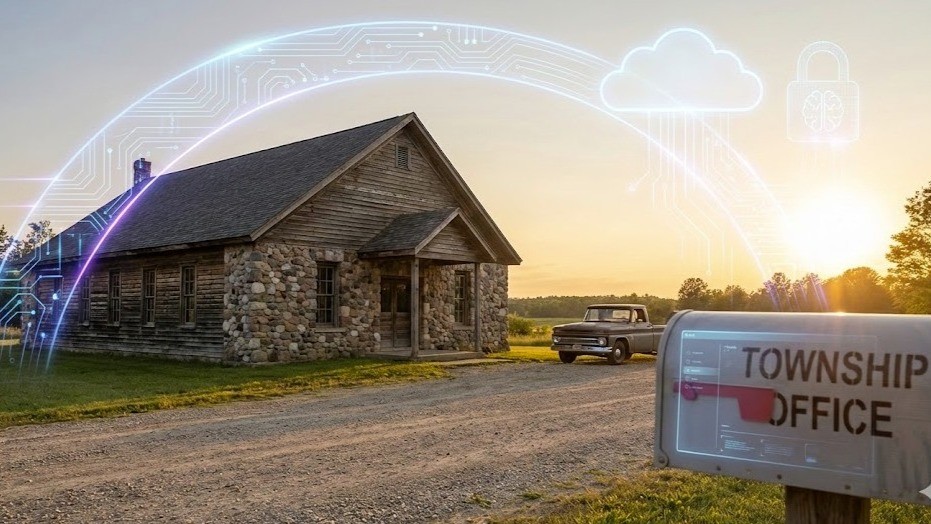
Author’s Note: Some of this is specific to Michigan local government, but it likely applies in your neck of the woods as well.
Most of us have watched this scene unfold with the same resigned familiarity we reserve for potholes in April. A township clerk, a caseworker, or the one person in the office who still knows how to unjam the copier is staring down a deadline. On one hand sits a 500-page federal regulation written in a dialect that can best be described as Legal Middle English. On the other, a complicated email begging for an explanation that will somehow satisfy both a constituent and their cousin who once attended law school for a semester.
The official method requires several hours, possibly caffeine, and at least one existential sigh. The faster method involves unlocking a personal phone and consulting ChatGPT or some other free AI tool that cheerfully digests the problem in seconds.
The employee feels productive. The taxpayer receives a prompt reply. Everyone goes home a little earlier. It feels tidy.
Unfortunately, in Michigan, that tidy moment has quietly produced what we might call a “Shadow Record”. Hidden from our retention schedules, stored on an unfamiliar server somewhere near the Pacific, yet still very likely subject to the Freedom of Information Act.
Our “paper-era” statutes are now attempting to coexist with the “algorithmic age”, and the two seem to be getting along about as well as a zoning ordinance and a rogue chicken barn. When we fail to provide staff with safe, affordable AI tools, the vacuum fills itself. Innovation doesn’t disappear. It simply moves into the shadows, taking our liability with it.
The Legal Reality: When “Possession” Stops Being Physical
For years, public bodies took comfort in a simple idea. If we didn’t physically possess the document, then we couldn’t reasonably be expected to produce it.
That certainty began to wobble with the Michigan Supreme Court’s 2020 decision in Bisio v. City of the Village of Clarkston. The Court held that records kept by a private attorney were still public records because the attorney’s work was used to carry out an official function.
While the case dealt with a contracted partner, the reasoning casts a long shadow over AI use.
- The employee acts as an agent of the public body.
- The tool is a third-party service such as OpenAI or Google.
- The output is used to perform governmental work.
Under this logic, the location of the record matters far less than how it shaped a public duty. The practical challenge is immediate. These AI systems do not hand back searchable logs or tidy archives. Yet a court may still decide the record exists, even if the public body has no earthly way to retrieve it.
It is hard to comply with FOIA when the information in question has politely evaporated into a vendor’s black box.
The Economic Wall: When Safety Becomes a Luxury Good
Perhaps, one might suggest, local governments could simply prohibit personal AI tools. After all, we’ve tried this with social media, and it went about as well as one would expect. Bans rarely survive contact with human ingenuity. When a process takes too long, staff naturally look for relief. AI offers relief in seconds. Policies struggle to compete.
The alternative is purchasing “safe” government-grade AI tools. The marketing promises sound comforting. The pricing, however, lands with the emotional weight of a millage that failed by three votes. Enterprise AI models often come with price structures that can stretch a local government budget in ways that feel all too familiar. For small or rural jurisdictions, even modest per‑employee increases can become difficult to justify when balanced against essential services. Worse yet, AI pricing shifts faster than a county board agenda during public comment.
Well-resourced municipalities can absorb these costs. Rural counties face an unkind choice. They can restrict the tools and watch employees use them anyway, or they can accept the risk and hope the FOIA requests arrive politely.
The Third Way: A Stateless Bridge
In Van Buren and St. Joseph Counties, our team at the Digital Innovation Collaborative Exchange has decided that neither option serves the public well. We can not justify the steep enterprise pricing, yet we also don’t want to build an organizational culture out of whispered workarounds. Instead, we are building what we call the Stateless AI Bridge.
Here is the structure.
The Vault: All official records remain inside our secure Microsoft 365 environment. They stay anchored where they belong.
The Brain: A secure AI model acts solely as a processor.
The Bridge: When an employee poses a question, the system retrieves the necessary material, processes it in volatile memory, and erases that memory as soon as the response is generated.
The AI never keeps a copy. It never stores embeddings. It never retains conversational logs. Meanwhile, the County will maintain its own audit trail. Every question and answer will pass through our own systems, where it can be located, logged, and reproduced to satisfy any FOIA request. We maintain the chain of custody without paying an “enterprise tax”. Because we use a consumption model, the cost aligns with actual usage rather than theoretical access.
The Bottom Line
Michigan needs a modernized framework, something akin to a Digital Sunshine Act, that clarifies obligations and updates retention rules for AI-driven work. Without legislative guidance, courts must interpret FOIA through analog traditions, even as our workflows drift steadily into algorithmic territory.
AI is no longer a casual productivity tool perched on someone’s personal phone. It participates in the work. In many cases, it shapes the work. Local governments cannot rely solely on bans or budgets to navigate this shift. Sometimes, the responsible path forward requires building the infrastructure ourselves, brick by digital brick.
I post these articles on linked in for several reasons, but mostly it’s to start the conversation and I want your feedback. We have decided to pursue this idea and we want to know what you think (I left out a ton of technical hocus-pocus, but we think its pretty feasible). Is this the right solution? Do you have a better idea that won’t cost us next year’s milk money?