


Author’s Note: This is the second article in a short series documenting my journey from just being “The GIS Guy” to a broader strategic role. If you haven’t read the first installment I encourage you to start there. The rest of this story will make much more sense with that context.
The Transformation Begins
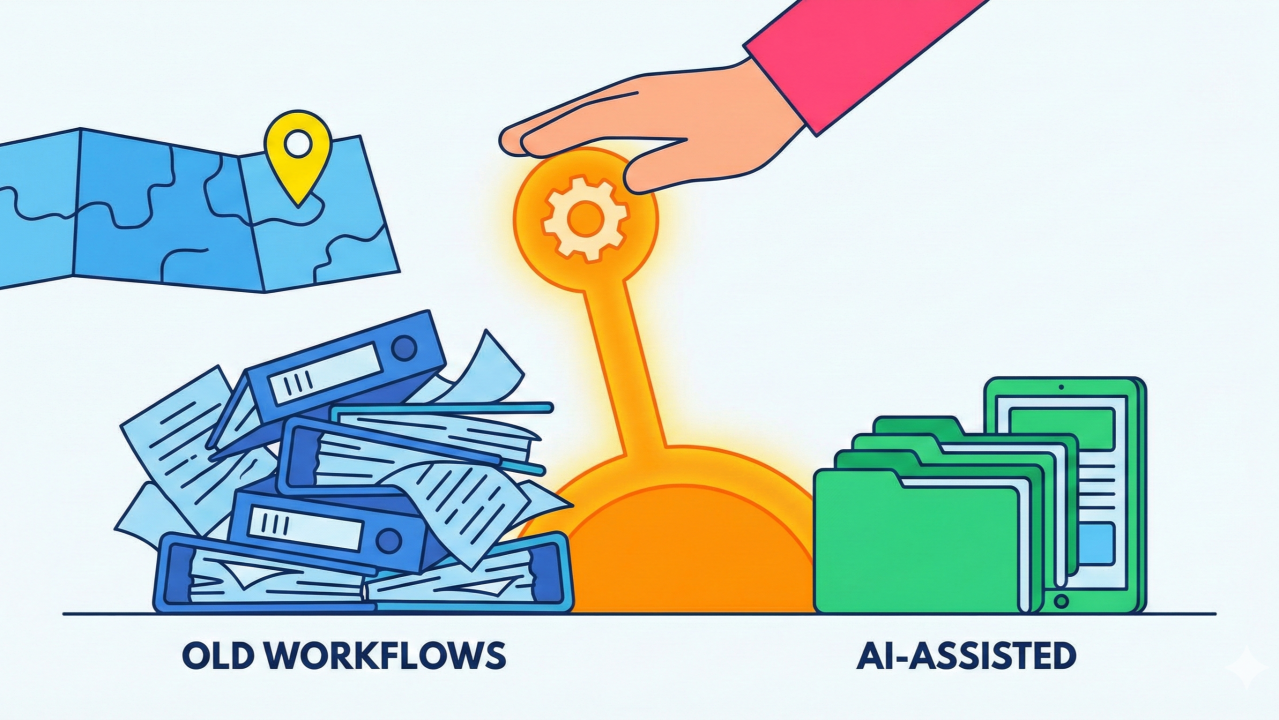
When ChatGPT arrived in late 2022, I did not see a threat. I saw a lever.
Local government rarely hands you levers. Mostly it hands you binders.
By then, GIS in St. Joseph County had been stripped down, stabilized, and largely automated. The chaos had been escorted out of the building. Data quality was improving. Workflows were clean enough to survive daylight. And for the first time in years, I had the rarest resource in local government: thinking time.
So I used it. Not casually. Relentlessly.
I tested AI against real county work, not conference demos or vendor promises. I learned prompt engineering the same way I learned GIS decades earlier, by breaking things, fixing them, and pushing until the edges became visible. This felt familiar. New tool, same discipline.
Two early discoveries convinced me this was not a passing fad.
The first was technical. With the right prompts, ChatGPT could translate a parcel’s legal description into a Michigan tax description, a compressed, highly specialized format that normally takes real effort and hard-earned experience to write correctly. The result was not magic. It was leverage. Expertise still mattered, but it traveled farther.
The second discovery was social, and more surprising.
I was presenting early findings to a room full of county department heads. AI anxiety filled the space. People were hearing science fiction scenarios, not productivity ones. The skepticism was polite, but firm.
On a whim, I asked ChatGPT to rewrite a bland internal report in the voice of a pirate.
The room changed instantly. People laughed. Shoulders dropped. The mood shifted. AI stopped feeling like an opaque system judging us from afar and started feeling like a tool that responded to direction. Something you could poke, steer, and correct.
That moment mattered more than it had any right to. It revealed something essential. Adoption rarely stalls on accuracy. It stalls on alienness. People hesitate when they cannot interrogate a system or influence its behavior. Tone flexibility exposed agency, and agency sparked curiosity.
After that, I was given the latitude to dig in.
From Experiment to Organizational Learning
In a small, resource-constrained county, AI is not a luxury item. It is a potential force multiplier. Administrators and colleagues understood this quickly. Or, as ChatGPT summarized in pirate dialect, “Aye, the winds be fair, the crew be willing, and the map says there be treasure if we dare sail.”
Still, one person can only carry experimentation so far. Prototypes prove possibility. They do not create endurance.
Around this time, I took on the GIS Director role for neighboring Van Buren County while remaining part time in St. Joseph County. Van Buren was familiar terrain. Bloated workflows. Antiquated processes. A department stuck in a comfortable rut that no longer served it.
We applied the same principles. Simplify. Streamline. Automate.
Workloads dropped. Clarity improved. When I demonstrated AI through concrete prototypes tied directly to county operations, administration and the board saw the implications immediately. This was not abstract transformation. This was fewer handoffs, fewer delays, and fewer things falling through the cracks.
IT departments in both counties were supportive, but wisely uninterested in owning this work. Infrastructure stability and security are heavy responsibilities. Experimental workflow design fits there about as well as a whiteboard fits in a server rack.
So we made a structural decision. We evolved our GIS departments into something new.
Clerical roles gave way to technical ones focused on AI, automation, and data systems. The mission shifted from map production to information flow. We rebranded the department as the Digital Information Department, or DID.
I preferred “Digital Innovation Department,” but innovation can sound adventurous to conservative boards, and not everyone enjoys adventure in their operating budgets. “Information” sounded responsible. The work remained the same either way.
Governance First, Tools Second
To avoid turning AI into a well-intentioned science experiment, we built governance early.
Each county formed an AI Task Force that met twice a month. These were not passive observers. They included technicians, judges, department heads, administrators, and elected officials; people who understood both opportunity and risk. At the executive level, AI Steering Committees set policy and guardrails.
One group explored. The other governed.
We wrote AI policies. We defined appropriate use. We tracked activity. We trained staff. We tried things. Some worked quietly. Some failed quietly. A few failed in ways that were educational for everyone involved.
Progress came from growing alongside the technology, not chasing it.
Low Hanging Fruit That Actually Mattered
We were intentional about where to begin. AI served first as a digital assistant, rewriting emails and clarifying reports, and as a digital secretary, recording meetings and drafting minutes.
At the same time, we leaned hard into automation using tools like Zapier and JotForms. We targeted the work no one brags about but everyone does. Tax billing address changes. Dog licensing. FOIA requests. Repetitive, low-judgment tasks that quietly consume thousands of staff hours.
AI handled cognition. Automation handled repetition. Expectations shifted accordingly.
The Chatbot Lesson: Garbage In Still Applies
One of the earliest visible wins was public-facing chatbots. Marty AI in Van Buren County. Joey AI in St. Joseph County. We used simple, affordable platforms like Chatbase that could be deployed quickly.
They taught us a blunt lesson.
A chatbot reflects the quality of the information beneath it. When we trained Marty on a messy, outdated website, he delivered messy, outdated answers. That was not a technological failure. It was a content one.
So we made a difficult but necessary decision. We ended our relationship with our website vendor and rebuilt both county websites from the ground up.
We did not build brochures. We built service platforms, designed to be readable by humans and machines alike. With two to three staff members, limited web experience, and extensive AI assistance, we rebuilt roughly 500 pages in three months in Van Buren County (the St. Joseph County rebuild is currently underway).
Once the structure improved, Marty improved with it.
- He now handles nearly 10,000 meaningful public conversations each year.
- He costs less annually than a daily cup of coffee.
- He saves an estimated 2,000 staff hours through reduced calls and emails.
- He is available every hour of every day.
That combination reframed the entire discussion.
The Constraint That Changed Everything
By this stage, we were operating across two counties with a team of three. We kept GIS running. We built AI tools. We automated workflows. We rebuilt digital infrastructure.
This was no longer operations. It was research and development conducted inside production systems.
That led to an uncomfortable realization. Efficiency alone does not justify staffing in local government. Time savings do not appear as budget line items. There is no account for hours no longer wasted. We were creating capacity, but not the kind that funds itself.
For this work to move from experimentation into sustainable production, the model had to change.
Along the way, one final truth became unavoidable. The limiting factor was never the AI. It was the data.
Without clean, accurate, authoritative, machine-readable information, advanced tools cannot deliver meaningful results. AI can reason only as well as the civic truth it is allowed to see.
Which brings us to the present.
We are building the next phase: a County Knowledgebase. A structured data layer designed to support not just chatbots, but any system that needs to reason from county truth. Marty 2.0 will not merely answer questions. He will help resolve problems, because the information beneath him is finally being treated as infrastructure.
That is the road ahead.
Article Three begins with the question this work ultimately forced us to confront: how do you build sustainable digital capacity in small local government when efficiency alone will never pay for it?