


Confessions of a GIS Lifer: Our Field Is Too Small for the Future
By Jerry Happel, Director of Digital Information, St. Joseph & Van Buren Counties, MI
Authors note: In a previous article, I explained why I no longer call myself a GIS professional. This is the story of what we’re building instead.
I’ve been in GIS for more than 30 years. That’s long enough to remember when a color plotter was the height of technological wizardry and “the cloud” was just a weather forecast. I’ve built GIS programs from scratch in both the private and public sectors, and I love this field.
Which is why it pains me to say this: in local government, GIS has gotten stuck in a rut.
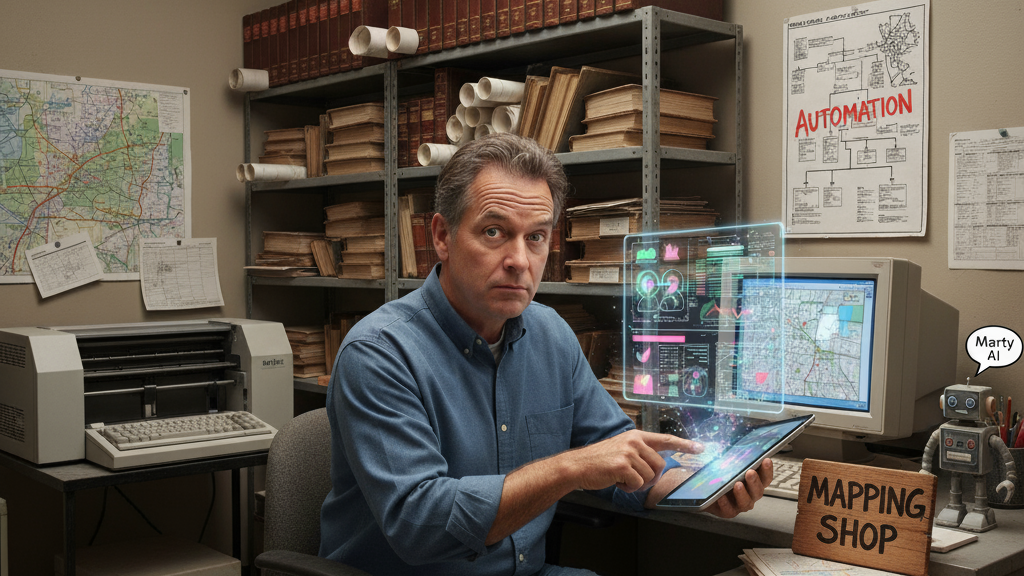
For decades, we’ve gotten comfortable. Maybe a little too comfortable. We’ve allowed ourselves to be defined by one vendor, a specific set of tools, and a single identity: the “mapping shop.” We’re the go-to people for a new zoning map, a quick property lookup, or that ever-popular request to “just add one more layer.”
It’s honest work, but it’s a professional dead end. While we are busy maintianing parcels, the rest of the world is sprinting into AI, automation, and data analytics. And if we’re not careful, we’re going to be lapped.
We Blew Up the “Mapping Shop”
In St. Joseph and Van Buren Counties, we decided our job wasn’t just to make maps, but to make government work better. So, we transformed our GIS departments into Digital Information Departments (DIDs).
GIS is still the bedrock of what we do, but it’s no longer the whole house. Now, our department is the county’s home for things that actually reduce headaches for staff and citizens:
- An AI that actually works. Our chatbot, Marty AI, answers over 10,000 resident questions a year. That’s 10,000 times a resident got an instant answer instead of playing phone tag, and hundreds of hours our staff got back.
- An allergy to paperwork. We’ve built automations to handle the tedious, repetitive tasks everyone hates but no one knows how to fix: parcel splits, FOIA requests, dog licenses, you name it.
- Digital access for everyone. We took dusty old survey notes and plat books, scanned them, and put them online, available to anyone, anytime, for free.
This is the work that matters. It’s visible, it’s impactful, and it’s the natural evolution of what GIS should have been all along: the data-driven problem-solving hub of the organization.
Why IT Can’t Lead This Charge
At this point, someone always says, “Shouldn’t AI and automation just go to the IT department?” It’s a fair question, but it misses the point of what an IT department is for.
Your IT department’s job, and it’s a profoundly important one, is to keep the lights on and the doors locked. Their entire world is built around stability, security, and risk mitigation. Their professional instinct is to say “no” to things that might threaten the network, and for good reason.
Our job as innovators is to punch a new window in the wall to let the light in.
Giving a transformative mission to a department whose primary success metric is “zero security incidents” is like asking a hawk to babysit a field mouse. It’s not that the hawk is evil; it’s just that its fundamental nature is eventually going to win out. You need a separate team whose mission is to build, to experiment, and to strategically change how work gets done.
The Small County Superpower
This is where my colleagues in smaller, rural governments usually say, “That’s nice for you, but we don’t have the resources.”
I’m here to tell you that you’ve got it backward. This is especially for you.
In a large city, GIS might have to fight for its seat at the table. But in a county of 60,000 people, there is no “Office of Innovation.” There is no army of business analysts. There’s just you. You’re the Swiss Army Knife. You’re the one person who understands data, knows technology, and has relationships with every single department.
In a small government, the GIS professional isn’t just an option to lead this change; you are often the only option. If you don’t do it, it will not get done. That’s not a burden; it’s a superpower.
The Crossroads: Map-Maker or Problem-Solver?
So, we’re at a crossroads. Every GIS leader has a choice to make, and it will define the next decade of your career.
Path #1: The Custodian. You can remain the trusted but tactical map-maker. You’ll be respected for your technical skill, but you’ll spend your days fulfilling requests from other people’s bigger projects. It’s a safe path, but it’s a role that will slowly be automated and marginalized.
Path #2: The Engine. You can become the indispensable, data-driven problem-solver. This path requires you to stop defining yourself by your software and start defining yourself by the problems you solve. Start by having coffee with your County Clerk and asking, “What’s the most annoying, repetitive part of your job?” Then, go back to your office and build a solution. Rebrand your team as “Digital Services.” Become the engine of transformation.
In my counties, GIS was the seed. The Digital Information Department is the tree. It’s time for the rest of us to get growing.
Authors Note: It’s clear many of you feel the same way. Now, I want to hear from you. Are you a GIS professional trying to break out of the box?Tell me in the comments or a DM: What have you tried? What worked? What barriers did you hit?.