


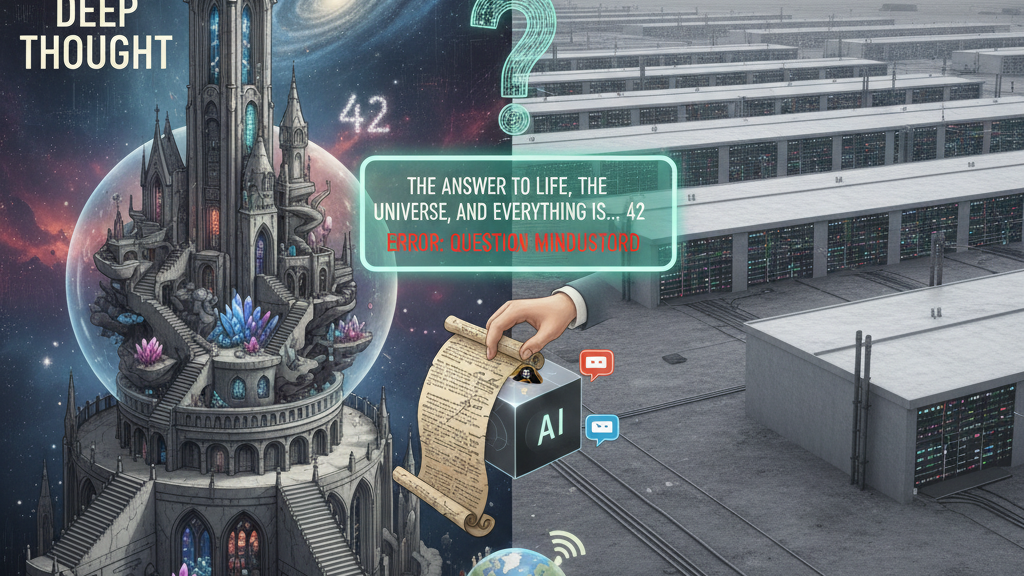
Douglas Adams and the Accidental Prophecy of AI Or: How We Ended Up Building Deep Thought with Fewer Marble Staircases
Douglas Adams was one of my favorite authors in my formitive teens. I recently re-read a few of his works and was struck by how much he predicted correctly in his tongue-in-cheek way. When Adams published The Hitchhiker’s Guide to the Galaxy in 1979, he wasn’t trying to predict the future of artificial intelligence. He was, more or less, trying to make a joke. Several, in fact. Most at the expense of bureaucracy, bad planning, and humanity’s occasionally misguided attempts to sound clever while being fundamentally confused.
And yet, here we are. Nearly half a century later, and Adams’ whimsical asides look unsettlingly like user stories for modern AI systems.
He was kidding. The universe, apparently, was not.
Deep Thought and the Data Centers of Mild Discomfort
Adams gave us Deep Thought, a computer the size of a planet, built to calculate the Answer to Life, the Universe, and Everything. It took 7.5 million years to generate its monumental reply: 42.
Fast forward a few decades. We now have planet-sized clusters of GPUs humming away in warehouses across Iowa and Oregon, racking up energy bills large enough to power small countries. All to generate similarly anticlimactic answers, just with slightly better syntax.
The satire, it seems, has been accidentally operationalized.
Where Deep Thought had gothic grandeur and existential flair, modern AI clusters have… uptime SLAs and multi-cloud redundancy. The aesthetic has suffered, but the effect is hauntingly similar: vast resources marshaled in pursuit of something we’re not entirely sure we asked the right question about in the first place.
A Long Wait for an Answer That Might Be a Punchline
Adams’ joke, of course, was that 42 was completely correct and entirely useless. A triumph of computation, undermined by a failure of framing.
This feels, how shall I put it, relevant.
In today’s AI world, we feed colossal models with more data than a bureaucrat could file in three lifetimes, and what comes out is often grammatically delightful, technically fluent, and profoundly unhelpful. Like a chatbot that can explain tax codes in the voice of a pirate, but can’t tell you which form you actually need to fill out.
Which begs the real question: is the problem with the machine, or the question we asked it? Prompt Engineering, anyone?
Recursive Design and the Earth-as-a-Computer Theory
In the books, Deep Thought, realizing its own limits, designs an even bigger computer: Earth. A device so advanced that it uses actual humans as part of its processing layer, without their knowledge or consent. (If this sounds familiar, you may have read the terms of service on a popular AI platform. Or, more likely, you didn’t.)
Today, every click, swipe, query, and poorly typed product review gets swept into the training datasets of modern AI. We’re basically unpaid interns feeding the algorithmic beast. As Adams imagined a planet-sized computer powered by oblivious participants, we built it. Then gave it Wi-Fi and started asking it to write our emails.
Even more unsettling: we’re now using AI to design the next generation of AI. Deep Thought builds Earth, Earth builds more Deep Thoughts. Someone really should have stopped the recursion back in Chapter 12.
Vogons, Bureaucracy, and the Local Government Procurement Framework
Then there are the Vogons, creatures whose love of paperwork is matched only by their gift for bad poetry. Their role in the galaxy is largely to ensure that things remain needlessly complicated, preferably in triplicate.
Here, Adams wasn’t even being metaphorical. In the realm of local government and AI, we regularly find ourselves translating transformative technology into outdated procurement templates, reviewed by seven advisory committees and a Data Ethics Board that only meets on alternate Thursdays.
And let’s not forget misalignment. The fact that machines often do exactly what we tell them to, with consequences that suggest they understood nothing whatsoever. It’s a problem in AI research, but also, arguably, in government forms where Question 4 invalidates everything you wrote in Question 3.
The Banality of the Algorithm
Adams didn’t predict AI so much as he predicted its feeling. Not killer robots or philosophical sentience, but the distinctly anticlimactic experience of asking something huge and important, then getting back a number, or worse, a politely worded confident sounding error (i.e. hallucination).
The real genius wasn’t in seeing the future of machines. It was in understanding the people who would build them.
So, for those of us navigating digital transformation in government: let this be a cautionary tale. If we don’t apply clarity, purpose, and a small measure of comic self-awareness, we risk building our own Deep Thoughts; expensive, impressive, and answering entirely the wrong question.
At DICE, we prefer a different approach. One grounded in real value, today. No 7.5 million year roadmap. No planetary-scale complexity. Just smart, practical tools that help people do useful things…..without needing to decode a galactic punchline.
Adams taught us what happens when the systems are magnificent, but the question is wrong. Our job now? Make sure we get the question, and the context, right.